

Online Tutoring, Online Language Learning
Why Fluent Students Still Miss the IELTS/TOEFL Score They Deserve
By Kat Rogan
In nearly 20 years of teaching English, I've sat across from hundreds of students preparing for IELTS and TOEFL — and one pattern shows up again and again. A student walks in already speaking at a genuinely strong level. Confident, fluent, easy to understand. And yet their practice scores land lower than their actual ability would suggest.
Almost every time, the reason is the same: they don't know the rubric.
Not the vocabulary. Not the grammar. The rubric — the specific criteria the examiner is trained to score against. Most students prepare by trying to "sound good." But examiners aren't grading a general impression of your English. They're grading you against a fixed set of criteria, and organization and logical thought process sit right at the center of it. A student who speaks beautifully but answers in a scattered, unstructured way will consistently score below a student who speaks more simply but organizes every answer clearly.
This is the gap I spend most of my time closing with exam-prep students — and it's worth understanding before you walk into the test.
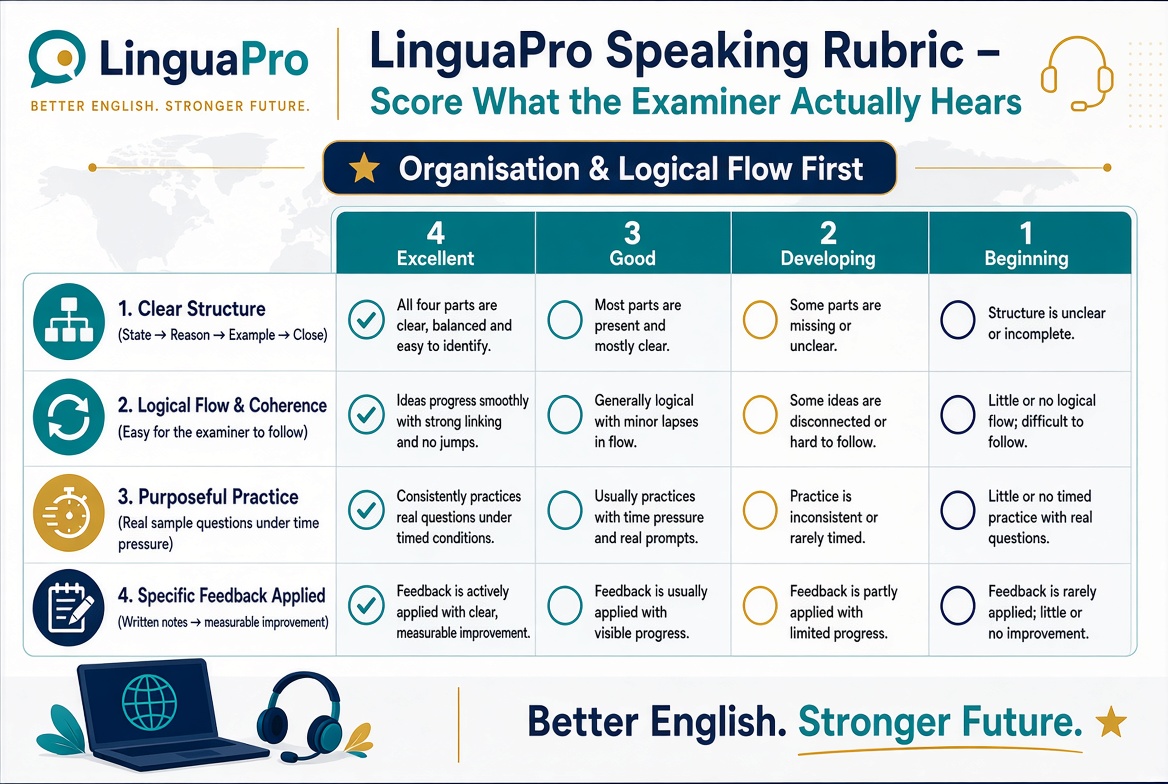
Understand the Rubric Before You Practice Anything Else
You can't train effectively for a target you can't see. IELTS and TOEFL both score speaking against specific, published criteria — fluency and coherence, lexical resource, grammatical range, pronunciation for IELTS; delivery, language use, and topic development for TOEFL. Most students have never actually read through these criteria in detail, so they're practicing blind, guessing at what "good" means instead of training toward what's actually being measured.
Once a student understands what the grader is listening for, their practice becomes purposeful instead of general.
Organization and Logical Flow Carry More Weight Than Students Expect
This is the biggest blind spot I see. A student can have excellent vocabulary and near-perfect grammar, but if their answer wanders, doubles back, or never quite lands on a clear point, the score reflects it. Examiners are listening for a response they can follow easily — a clear beginning, a developed middle, and a conclusion that actually answers the question.
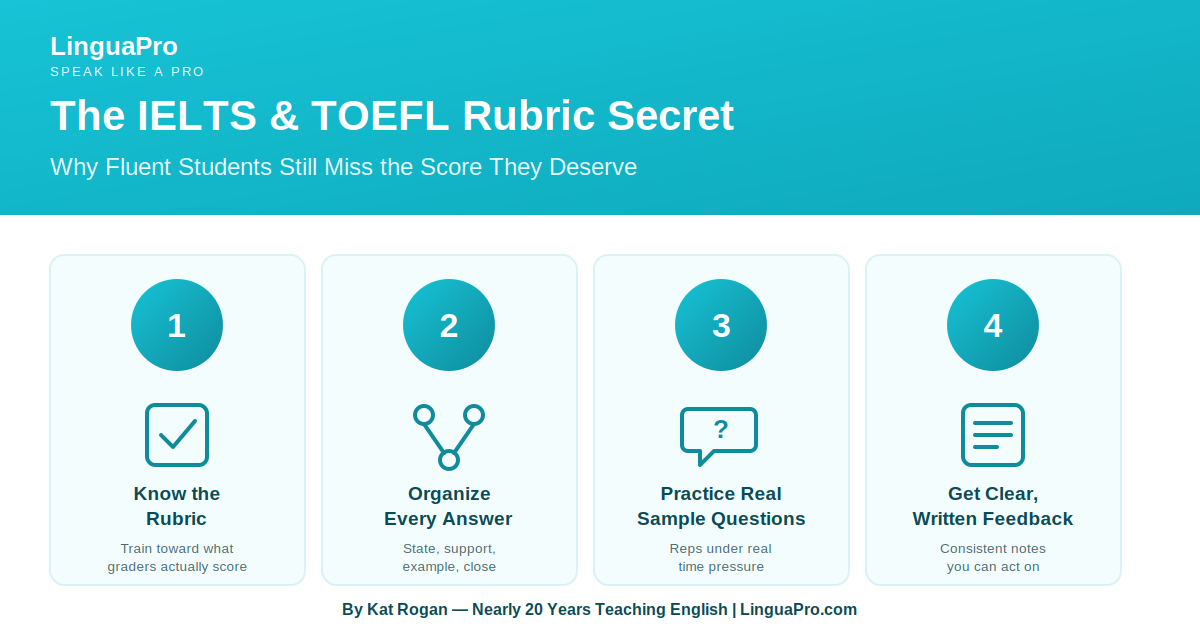
I teach my students to build every answer on a simple, repeatable structure: state your answer directly, support it with a reason, back the reason with a specific example, then close. It sounds almost too simple, but it's the difference between an answer that sounds impressive and one that scores well — those aren't always the same thing.
Practice With Real Sample Questions, Not Just General Conversation
General conversation practice builds comfort, but it doesn't train the specific skill the test demands: organizing a complete, well-structured answer inside a strict time limit, on a topic you didn't choose. That skill only develops by working through real sample questions, repeatedly, with a clear agenda — not random chat practice.
I have students work through authentic sample questions and treat every answer as a rep: state, support, example, close, every single time, until the structure becomes automatic under pressure.
Consistency, With Clear Feedback You Can Actually Use
Improvement here isn't about one great session — it's about consistent, structured practice paired with feedback the student can actually act on. I make a point of giving my students clear, written lesson notes after every session: exactly what worked, exactly what to tighten, and what to focus on next time. Vague feedback like "good job" or "work on fluency" doesn't move a score. Specific, written notes a student can review and apply do.

The Real Gap Isn't Ability — It's Awareness
Most of the students I work with already have the English to succeed. What's usually missing is the awareness of how they're being graded, and a structure to organize what they already know how to say. That's a fixable gap, and often a fast one to close once a student sees it clearly.
Prepare With a Tutor Who Teaches to the Rubric
At LinguaPro, our exam-prep sessions are built around exactly this — understanding the grading criteria, practicing real sample questions with a clear organizational structure, and reviewing detailed lesson notes after every session so you know exactly what to work on next. You already have the English. Let's make sure the score reflects it.
🎯 Book an IELTS/TOEFL Speaking Session TodayFind an Exam Prep Tutor →

#LinguaPro #IELTS #TOEFL #ExamPrep #LearnEnglish #EnglishSpeaking #OnlineTutoring