
As both a teacher and a learner, I have spent a lot of time thinking about what makes an online teaching platform genuinely useful. There are plenty of websites where students can find teachers, plenty of video platforms for conducting lessons, and countless sites offering games, worksheets, videos, and other English teaching resources.
The problem is that these things are usually scattered everywhere.
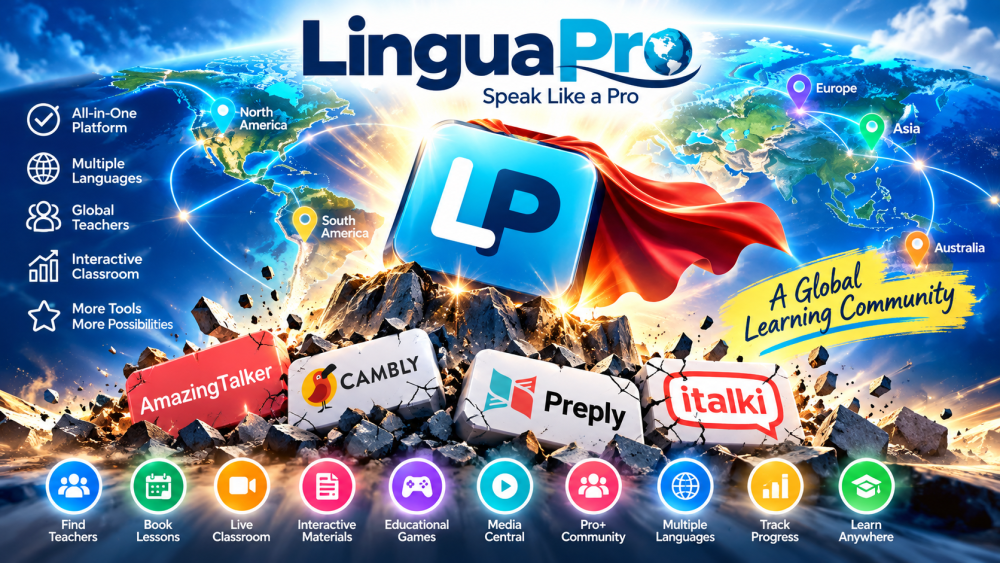
That is what makes the changes taking place at LinguaPro so interesting to me. Instead of functioning as just another website for booking online English lessons, LinguaPro is becoming a complete online teaching and learning ecosystem—a place where teachers and students can find almost everything they need within one connected environment.
From my perspective as both a teacher and a learner, that makes an enormous difference.
Everything in One Place
Online teaching can become surprisingly complicated. A teacher might use one service for video calls, another for scheduling, another for payments, another for lesson materials, another for games, and still another for communicating with students.
Students experience the same fragmentation. They receive a video link from one service, messages somewhere else, lesson materials through another application, and perhaps use yet another website to practice what they are learning.
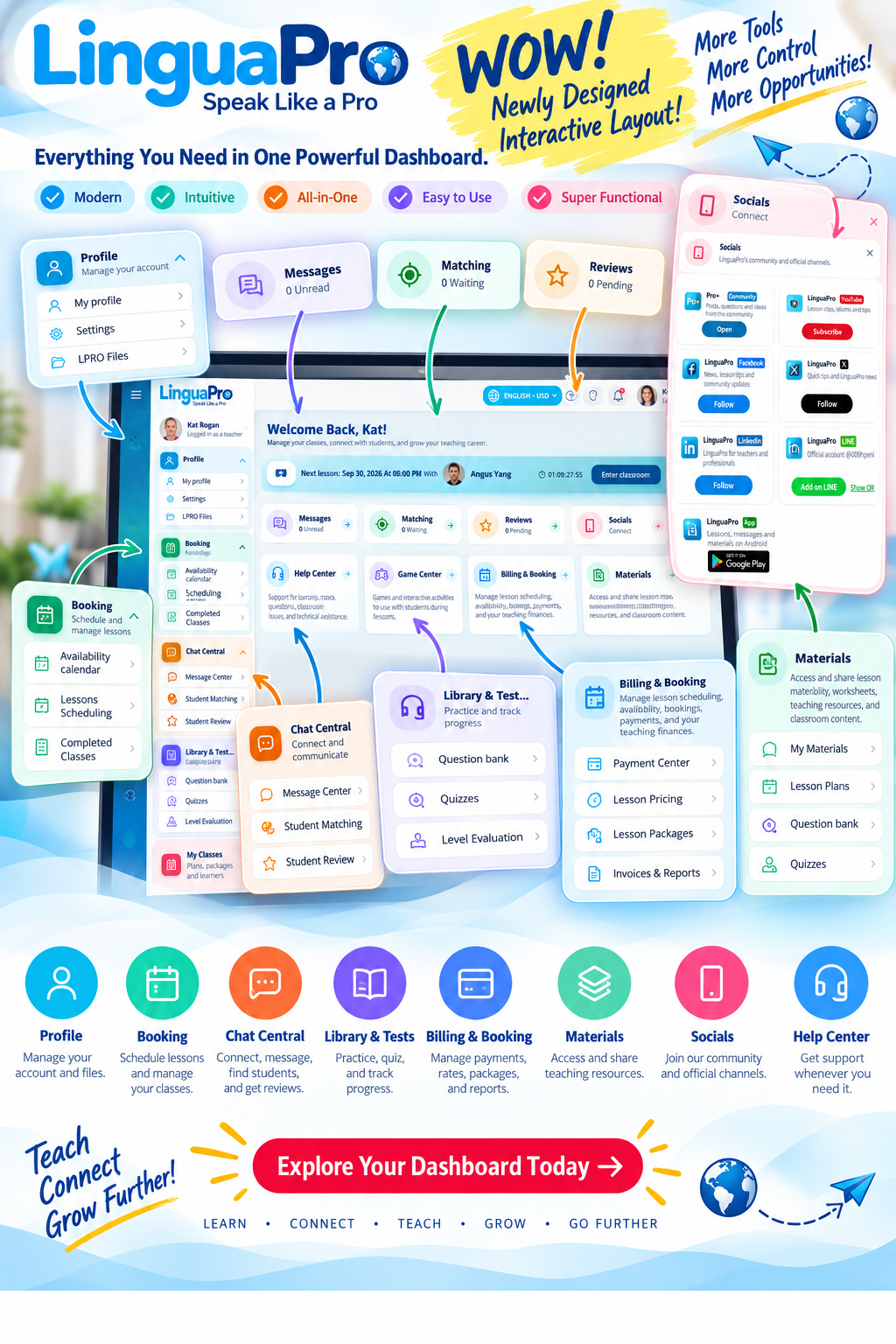
LinguaPro takes a much more integrated approach. The platform brings together many of the things teachers and students normally have to find separately:
- Professional teacher profiles and teacher search
- Lesson booking, availability, calendars, and notifications
- Integrated online classrooms
- Teacher and student messaging
- Payments and teacher earnings
- Interactive teaching materials
- PDF reading and annotation tools
- Educational games and classroom activities
- Media Central and educational video content
- Pro+ community features
- Learning resources and the LinguaPro Store
- Integrated multilingual support for a worldwide audience
That is much more than an online English teacher marketplace. It creates an environment where the entire learning relationship can take place.
From Booking a Teacher to Actually Learning
One of the biggest differences I see between teaching platforms is what happens after a student books the lesson.
Finding a teacher is important, but that's only the beginning.
Once a student has chosen a teacher, the platform should continue helping both of them. Scheduling, reminders, communication, materials, classroom tools, activities, and follow-up should feel like parts of the same experience.
With LinguaPro, the journey can remain connected:
Find a Teacher → View Their Profile → Book a Lesson → Pay → Receive Reminders → Enter the Classroom → Learn → Use Materials → Play Interactive Games → Review the Lesson → Communicate → Book Again
That simplicity is valuable from both sides of the classroom.
As a teacher, I want to concentrate on teaching rather than managing a collection of websites.
As a learner, I want to concentrate on learning rather than figuring out which application I am supposed to open next.
A Virtual Classroom That Belongs to the Platform
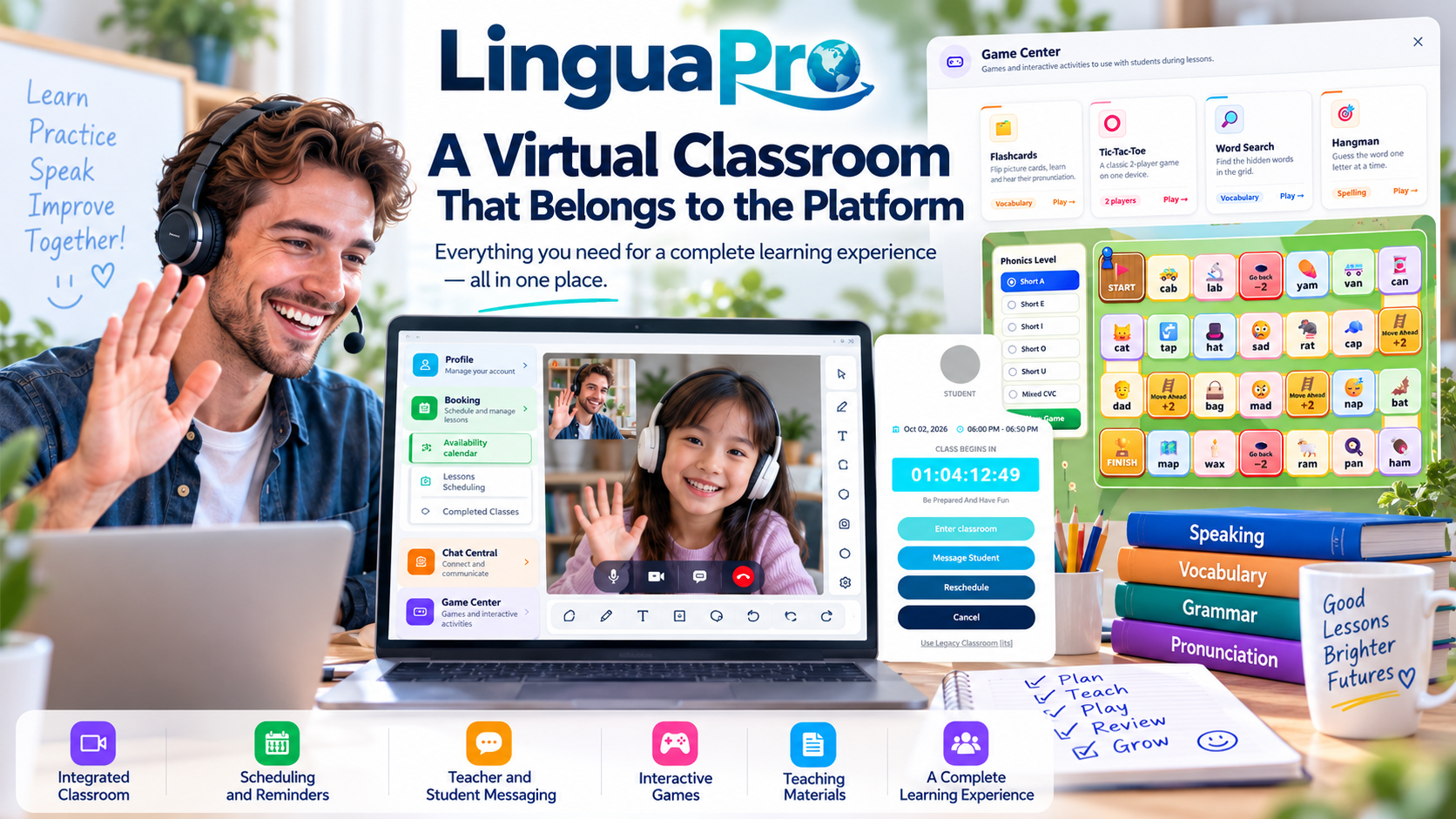
The integrated classroom is an important part of this ecosystem.
Many online teachers are accustomed to using a teaching website for booking and then leaving that website when it is time for the actual lesson. Suddenly the student and teacher are somewhere else.
LinguaPro keeps the classroom connected to the rest of the experience.
This means the virtual classroom, scheduling system, teacher profile, student account, lesson information, materials, and other teaching tools can function as parts of the same platform.
That creates continuity.
For me, that is one of the most important qualities an online teaching platform can have. Technology should make a lesson easier, not create more steps between the teacher and student.
Interactive Materials That Teachers Can Actually Teach With
Another change I particularly like is the direction LinguaPro is taking with teaching materials.
There is a big difference between storing a PDF and actually being able to teach with it.
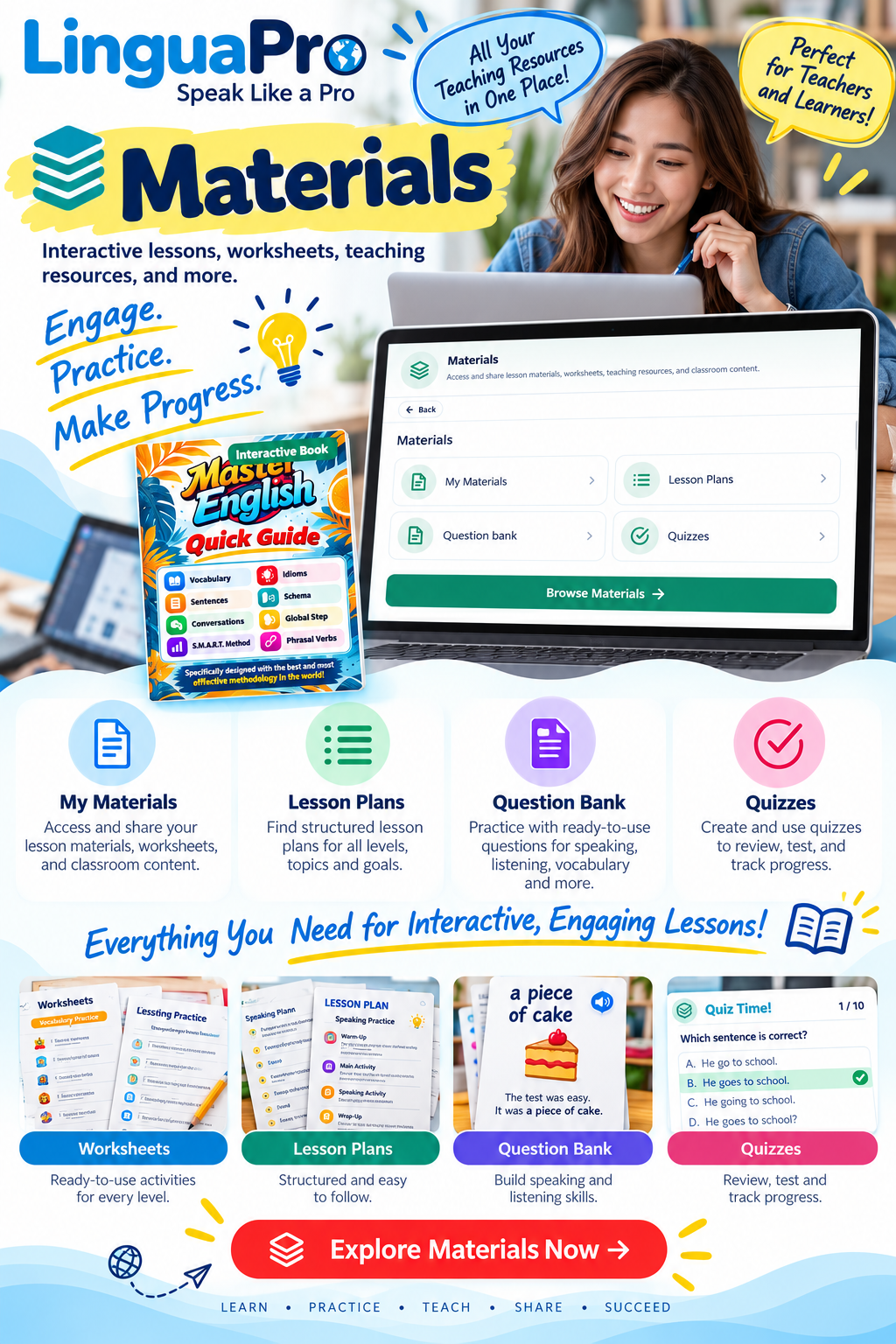
The Interactive Materials Reader is designed to make lesson materials part of the classroom experience. Teachers can work with documents using features such as close zooming, page navigation, drawing, and annotation rather than simply sending students a file and asking them to open it separately.
This gives teachers another practical tool for working with:
- ESL lesson materials
- Reading exercises
- Vocabulary
- Grammar
- Pronunciation
- Comprehension
- Conversation activities
- Visual learning materials
For an online teacher, those seemingly small improvements can completely change the flow of a lesson.
Interactive Games Bring Another Dimension to Learning
Not every minute of a language lesson should feel like studying.
Students need opportunities to experiment with English, make mistakes, respond quickly, laugh, compete, and simply use the language.
That is why I like seeing interactive learning becoming a larger part of LinguaPro.
The Game Center provides activities teachers can incorporate directly into their lessons. Games such as Bingo and Pronoun Trail can turn vocabulary, grammar, numbers, spelling, and sentence practice into something much more engaging.
These tools aren't intended to replace teaching.
They make the teacher's toolbox bigger.
A teacher can move from explanation to reading, from reading to conversation, from conversation to an interactive activity, and then back into the lesson—all without continually sending the student to different websites.
The Student Experience Matters Just as Much
Looking at the platform as a learner changes my perspective.
Students generally aren't interested in the technology behind an online lesson. They want everything to work.
They want to find a good teacher, understand the teacher's availability, book a convenient time, make a payment, receive reminders, enter the lesson, communicate with their teacher, and access whatever they need to learn.
The technology should almost disappear.
That is why the ecosystem approach makes sense. Instead of expecting students to understand how several independent systems fit together, LinguaPro can provide one central home for their learning.
The student's relationship is with their teacher and their education, not with a collection of software products.
Learning Doesn't Have to End When the Class Ends
This is where Media Central becomes particularly interesting.
Language learning doesn't happen only during a scheduled lesson. Students learn from videos, demonstrations, conversations, explanations, stories, examples, and simply being exposed to more English.
Media Central gives that kind of content a home within LinguaPro.
A student can come to the platform for a lesson but also have reasons to return when no lesson is scheduled.
That changes the nature of the website.
It becomes less of a place you visit for an appointment and more of a learning environment.
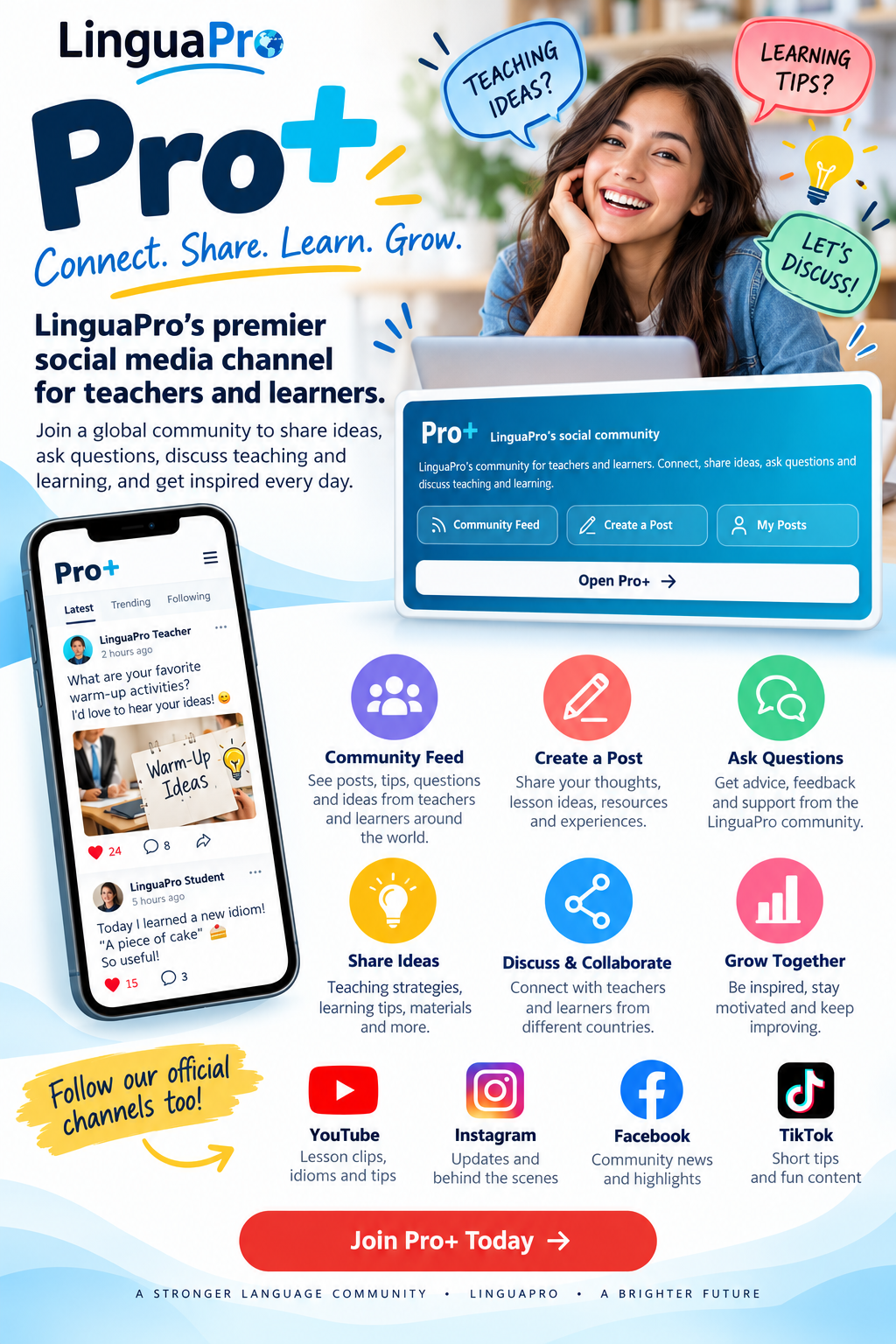
Pro+ Brings in the Social Side of Language Learning
Language is communication. That means there is naturally a social element to learning it.
Pro+ extends LinguaPro beyond private lessons by adding a community dimension to the platform. It creates opportunities for teachers and learners to remain connected with the broader LinguaPro environment.
When combined with Media Central, messaging, teacher profiles, lessons, games, and educational materials, the platform begins to feel less like a collection of features and more like an actual community.
And that is where the ecosystem idea really becomes apparent.
Teachers + Students + Classroom + Materials + Games + Media + Communication + Community + Payments + Store
Each part supports the others.
A Truly International Learning Platform
Another area that stands out to me is LinguaPro's increasingly international approach.
If an online English learning platform wants to serve the world, it needs to do more than simply make an English-language website available internationally.
Language itself is one of the first barriers that has to disappear.
LinguaPro's integrated language system is expanding to support major international markets, including Traditional Chinese, Simplified Chinese, Japanese, and Korean, among others.
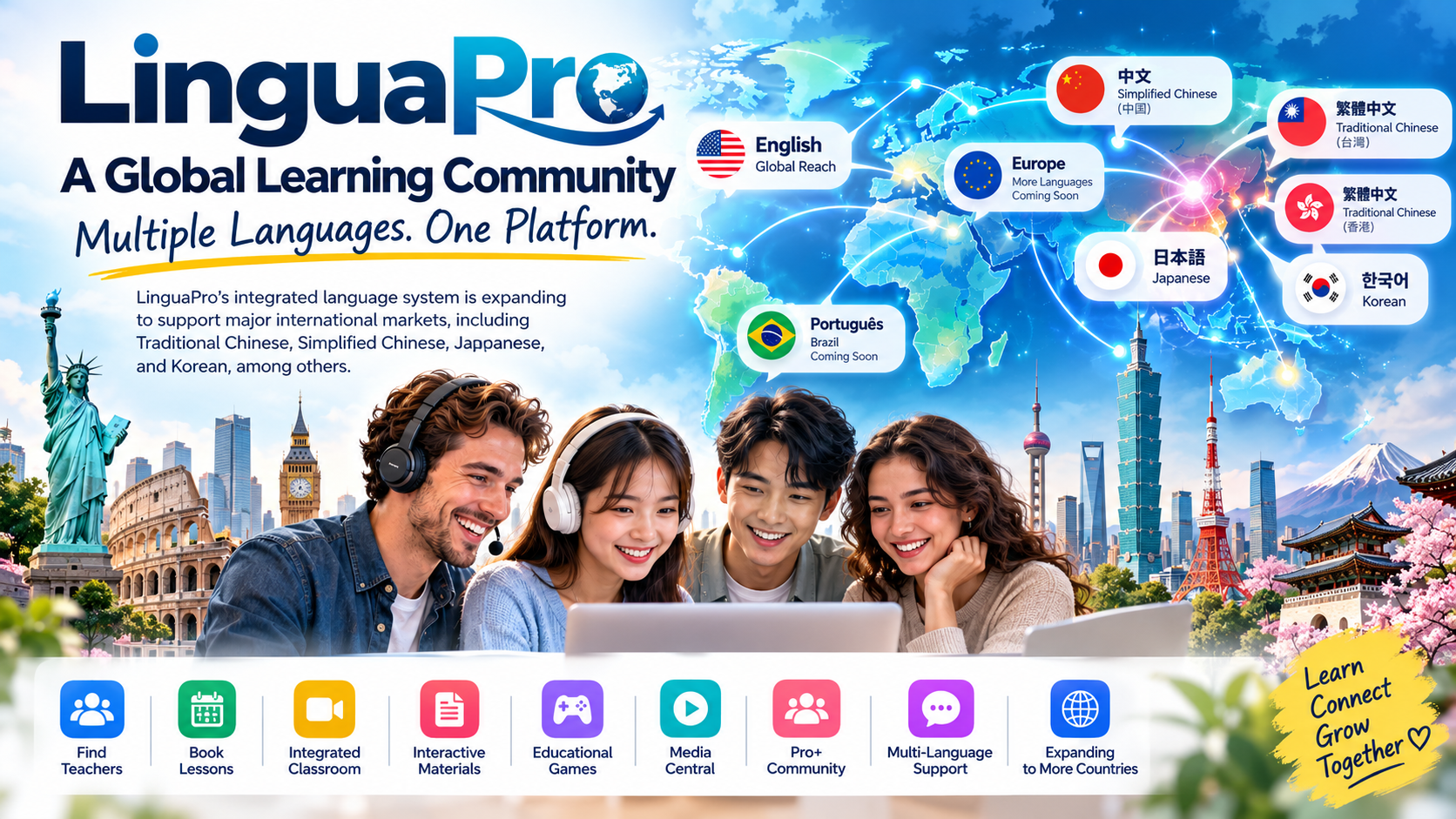
The Japanese and Korean integration is especially significant because the platform itself can increasingly handle multilingual information rather than placing the burden on individual teachers to manually translate ordinary profile information into every supported language.
The Chinese-language system also allows LinguaPro to better serve different Chinese-speaking markets, including Taiwan, mainland China, and Hong Kong.
That is what I expect from a platform designed for a worldwide teaching market.
The teacher might be in one country. The student might be thousands of kilometers away. They might normally navigate the internet in completely different languages.
The platform's job is to bring them together.
Teachers Need More Than a Listing
Another thing I appreciate as a teacher is the emphasis on the teacher's professional presence.
On some teaching marketplaces, a teacher can begin to feel like another photograph in a giant directory.
But a good teacher brings personality, experience, teaching style, materials, communication skills, and relationships with students. A teaching platform should help teachers demonstrate those qualities.
Professional profiles, reviews, availability, lesson packages, communication tools, classroom features, teaching resources, and payment management all contribute to that professional presence.
The platform provides the infrastructure.
The teacher provides the teaching.
That balance is important.
More Than a Long List of Features
Any one of these features can be found somewhere else.
There are websites with virtual classrooms. There are scheduling systems. There are English learning games. There are PDF readers. There are teacher marketplaces, social networks, educational videos, online stores, messaging applications, and payment systems.
The interesting part of LinguaPro isn't simply having another feature.
It's connecting them.
When the teacher profile connects to booking, booking connects to the calendar, the calendar connects to the classroom, the classroom connects to materials and games, and the lesson connects back to communication and community, the experience becomes much more powerful.
Instead of asking, "How many features does this website have?” I think the better question is:
"How much of my teaching or learning can I actually do here?”
For LinguaPro, that answer is becoming: almost everything.
Why LinguaPro Tops Other Online Teaching Platforms
There are many good online teaching platforms, and different teachers and students will always have different priorities. Some people want a large teacher marketplace. Others are primarily interested in video lessons, teaching resources, or inexpensive classes.
When I look at LinguaPro from my own perspective as both a teacher and learner, however, its greatest strength is clear.
Everything is coming together in one place.
I can look at it as a teacher and see the tools I would actually want for teaching English online: students, scheduling, communication, payments, a virtual classroom, interactive materials, educational games, media, and professional tools.
Then I can look at exactly the same platform as a learner and see something completely different: teachers, online English lessons, materials, activities, videos, communication, community, and a straightforward path through the entire learning experience.
Add an integrated multilingual system designed for markets including Japan, Korea, Taiwan, China, Hong Kong, and beyond, and the possibilities become much larger than a conventional online teaching website.
That is why I believe LinguaPro stands apart.
It isn't trying to be just another place to book an English lesson.
LinguaPro is becoming a complete global teaching and learning ecosystem—bringing teachers, students, technology, resources, and community together in one place.


