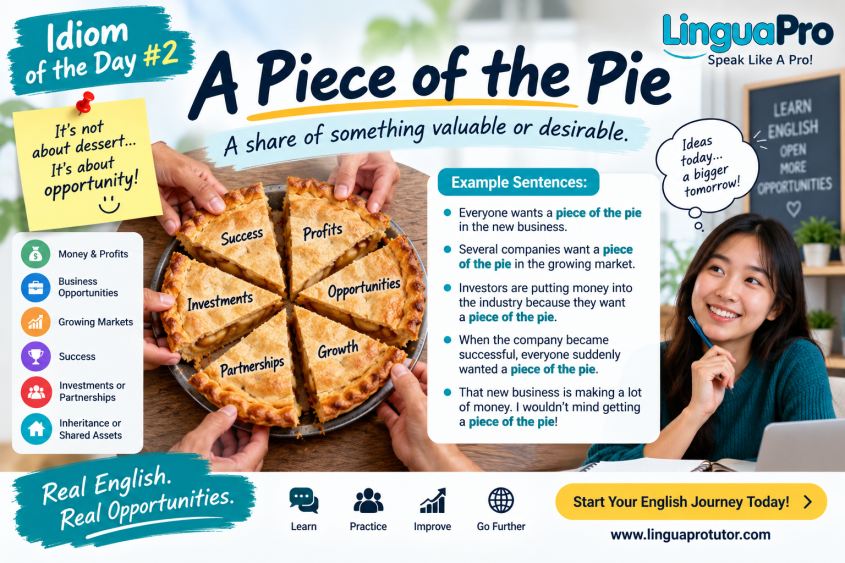
Have you ever heard someone say, "Everybody wants a piece of the pie”?
They probably weren't talking about dessert. 🥧
"A piece of the pie” is a common American English idiom meaning a share of something valuable or desirable—usually money, profits, business, opportunities, or success.
After more than 20 years of teaching English in Asia and online, I've found that expressions like this are especially useful for students who want to understand real conversational and business English. Native speakers use phrases like "a piece of the pie” naturally, often without even realizing they're using an idiom.
Imagine a pie sitting on a table.
Several people want some, but there's only one pie. If the pie is divided among everyone, each person receives a piece of the pie.
The idiom works the same way.
The "pie” represents something valuable, and your "piece” represents your share of it.
For example:
Everyone wants a piece of the pie in the new business.
Nobody is actually eating pie. It means several people want to share in the company's opportunity, profits, or success.
You'll often hear "a piece of the pie” when people are talking about:
It's especially common in business English.
Imagine a new industry is growing rapidly and making a lot of money. Other companies notice the opportunity and begin entering the market.
You might hear someone say:
"Everybody wants a piece of the pie.”
That means everybody wants to benefit from the opportunity.
Business:
Several companies want a piece of the pie in the growing market.
Money:
When the company became successful, everyone suddenly wanted a piece of the pie.
Investment:
Investors are putting money into the industry because they want a piece of the pie.
Inheritance:
Everyone in the family wanted a piece of the pie when the property was sold.
Everyday conversation:
That new business is making a lot of money. I wouldn't mind getting a piece of the pie!
Don't confuse today's idiom with Idiom of the Day #1 — "A piece of cake.”
They sound similar, but their meanings are completely different.
A piece of cake = Something is very easy. 🍰
The English test was a piece of cake.
A piece of the pie = A share of something valuable. 🥧
Everyone wants a piece of the pie.
That little word "the” makes a big difference!
You could simply say:
"Everyone wants a share of the profits.”
That's perfectly correct English.
But a native speaker might naturally say:
"Everyone wants a piece of the pie.”
Learning idioms isn't about replacing normal English with complicated expressions. It's about being able to recognize and comfortably use the English that people actually speak.
That's one of the things I emphasize with English learners: vocabulary and grammar give you the foundation, but understanding expressions, context, and natural speech helps you become a more confident communicator.
Complete this sentence:
The new company is becoming very successful, and everybody wants ____________.
Did you say "a piece of the pie”? 🥧
You've got it!
Now try making your own sentence using today's idiom. The more you actually use new expressions, the easier they'll be to remember.
This is Idiom of the Day #2 in our continuing English learning series.
We'll keep exploring the expressions native English speakers use every day—what they mean, when to use them, and how to use them naturally.
Want to put your English into practice with a real teacher?
🌟 Check out our FREE Trial Lessons and meet our teachers today!
LinguaPro — Speak Like A Pro.
— Teacher Kat Rogan, Owner, LinguaPro LLC